Monday, July 1, 2013
About today's column...
My new weekly series on THE DEATH OF SUPERMAN will have to wait a week for technical difficulties. Stay tuned.

Superman Daily Comic Strip: "The Comeback of Larry Trent"

Hey guys, I have a bit of an oddball recommendation today.
The book you see above is wonderful collection of the daily Superman comic strips that were syndicated cross country in 1939. At this early point in the history of the comic book, comic strips which were well established throughout the great newspapers were considered far more prestigious than monthly comic books. Adventure strips, now a dying medium, often employed the finest cartoonists in the country and Superman joined the ranks of strips like The Phantom, Buck Rogers, and Flash Gordon. Superman made his debut in the newspapers in January of 1939, six months after Action Comics 1 hit newsstands, and would run continuously (along with a separate Sunday strip) until 1966. Counting a late 70's revival Superman has appeared in over 12,000 original strips. I find these collections not only a look at Superman in the form his creators intended for him, but also an opportunity to follow an adventure strip, which I've never been able to do in newspapers as they're published in the paper.
I've been working my way through the first year of the black and white daily strips, and my favorite story in the lot is the third one, entitled "The Comeback of Larry Trent." After the first long form version of the origin on Krypton (which is named here for the first time) and a retelling of Superman's first case, Siegel gives us a wonderful oddball story about Superman helping a broken down prizefighter and exposing corruption in boxing. There other stories that contain more iconic Superman imagery, but the plot of this story is just so bizarre that it's stuck in my head ever since I read it weeks ago. It's also so indicative of what's different about the Golden Age version of the character that it really recommends itself to a review on this blog.
When Superman saves former world champ Larry Trent from falling to his death Trent tells Superman that his life has become meaningless since his manager drugged him and cost him the title. Superman agrees to help Trent get into fighting shape while he fights his way back to an title shot in disguise. Superman, disguised as Trent, grabs the attention of Trent's former mob handlers, who try to cheat Superman the way they cheated Trent with predictable results. In the end, Trent wins back his title, Superman ferrets out the corruption, and Clark Kent receives a major promotion for his coverage of both stories.
What makes this unique? First, it's a human-interest, small scale story in which Superman not only saves a man from dying, but mounts a significant operation to restore his life. This story would be almost impossible just a couple years later when Superman's focus had widened to encompass the entire world. Secondly, Superman has no problem using his physical prowess on, presumably innocent, boxers who get in his way. This is still a raw and rough and tumble Man of Steel. Third, it's fun to see Clark get one over on his fellows by using Superman to help his journalistic career.
A fun romp that will be of interest toi any fan of classic comics, or Superman in general.
Friday, June 28, 2013
Action Comics (vol. 2) Issues 9-12; 0: "Bulletproof"

Welcome to the second part of my series on Grant Morrison's revamp of Action Comics! Last time we covered Superman's first showdown with his two greatest adversaries, as well as Superman and the Legion taking on the Little Man's Anti-Superman Army for the only piece of kryptonite in existence. Those issues formed a more or less cohesive story, but here is where Morrison's larger second story begins to take shape. Many of Morrison's most robust themes with regards to Superman: his status as a trans-universal archetype; the role of mass media and corporate branding on him; his impossible enemies; his essential humanity and heroism; get a more robust treatment here than they did in the first segment. Let's dive in.

Issue 9: "The Curse of Superman"
This issue seemed to be another digression at first-- a discussion of creator rights, corporate domination, and short-sighted political idealism smuggled into a backdoor pilot for his long discussed Multiversity series, but in coming back a year later, this issue is the one that feels the most like a microcosm of the entire series. What is essential to the superhero beyond his status as a corporate spokesperson? Why does he endure? Morrison has no pat answers here, frustratingly so for a writer who has had so much to say about this kind of conceptual work in New X-Men and JLA, but he is frightfully clever in this issue.
Consider the reappearance of his "Obama-Superman" from Final Crisis, a year earlier. The relentless optimism that character seemed designed to evoke is tempered by the first real indicia that the author(s) understand how scary a Superman who felt entitled to the office of President would be. This President can execute his OWN drone strikes. That said, he exists to serve a story function first and foremost: a Superman who is close enough to our own that we freely recognize him as partaking in the archetype, but different enough to remain distinct and justify his existence.
Confronting this new Superman are three distinct forces: a Lex Luthor who is much further along in his evolutionary process than our own, a Lois Lane who has sold out to the Little Man unknowingly and created a monster but who retains her essential heroism, and Superdoom a tulpa corporate Superman and who is rendered by stooges as "...a violent, troubled, faceless anti-hero concealing a tragic secret life, a global marketing icon." Which seems as much a condemnation of bloodthirsty comic book fans as it does the mass media corporations that control them.
The heroes win themselves a temporary respite, but the question has been raised: Can Superman exist as something more than a brand name and logo? The rest of Morrison's run is an attempt to find not so much closure as a possibility space for a real (in a psychological sense) Superman to survive both the original sin that created him (Siegel and Shuster sold him for a mere 200 dollars and watched their creation birth a media empire while losing all control over him) and the continuing exploitation by people who have no interest in what the icon represents and seek to use him as a distraction from, and not a call to solve, the world's problems. Morrison is recasting the entire world as a superhero comic, and it's daring if not totally realized work.
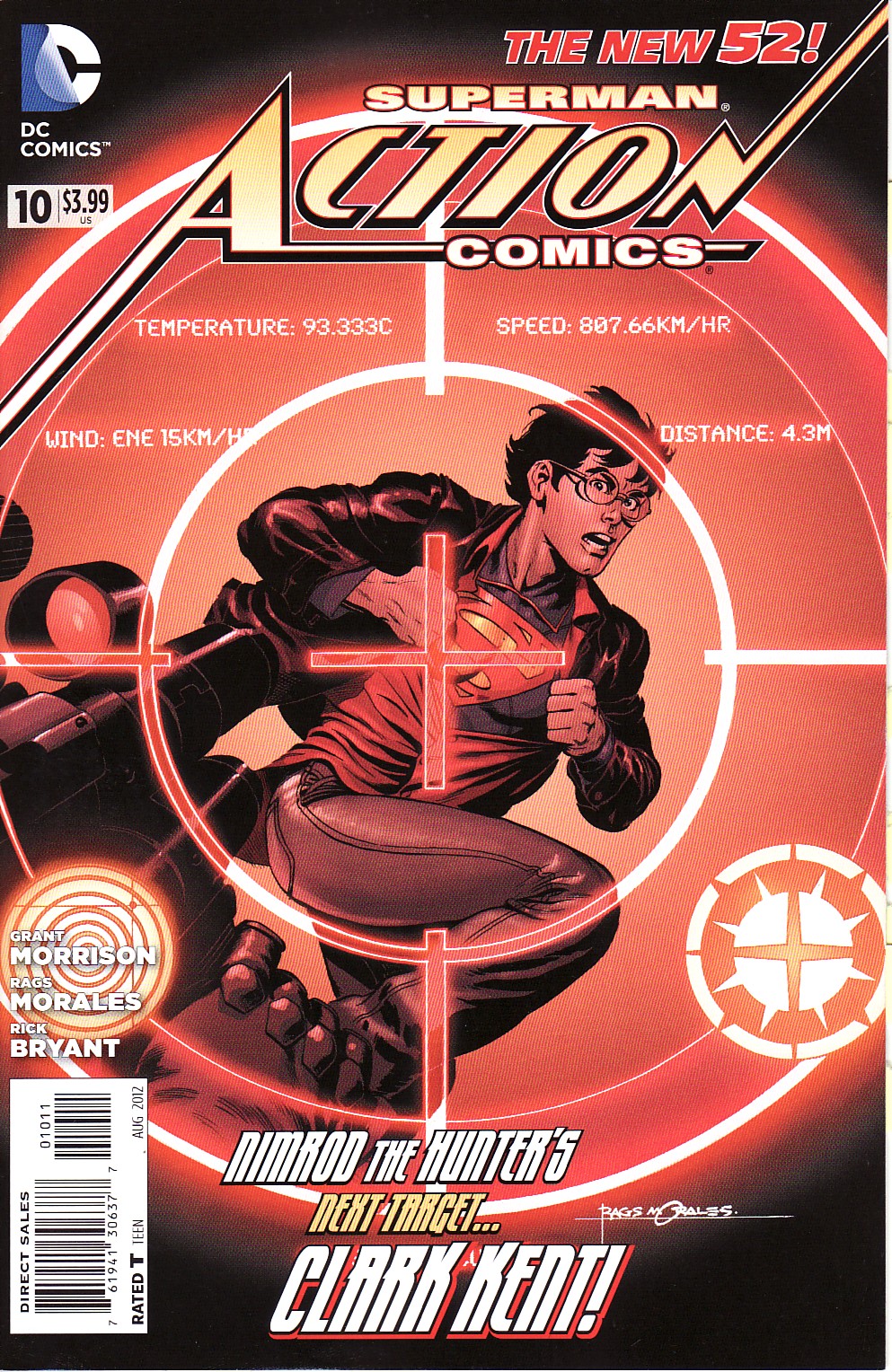
Issue 10: "Bulletproof"
A senseless murder, which Morrison has the good taste to merely allude to, triggers a crisis of conscience for the Man of Steel even as he's being hunted by the Little Man's latest pawn, Nimrod the Hunter. When a former associate of Glen Glenmorgan blows himself up to try and kill Clark Kent, Superman decides to use the incident as an opportunity to excise his human alter ego, and continue on as Superman 24/7.
This issue is the inverse of Issue 3, whereas there the Superman persona had been tarnished and attacked and Clark seemed willing to abandon it, here the real evil that humans are capable of, and the rest of the Justice League's hesitation to tackle it lead Clark to a huge blunder-- renouncing his human identity. Superman even tells a murderer he'll let "your kind" deal with him, which is a sign that he's in a bad place emotionally. Fitting that his Justice League compatriots seem all too human in their brief appearance; they're more concerned with their own secret identities (Batman) and families (The Flash) than with the systemic causes of human tragedy.
If the first portion of this run saw Clark learn that Superman must be a symbol and not a bully, this portion will teach him that he cannot become a symbol at the expense of being a man. The retooled Captain Comet who is shown coming to Metropolis will serve as a stark portrait of a "superman" who is unburdened by the concerns of the average man, and seeks to impose his will on the world writ-large. The subplot of Nimrod coldly stalking Superman through his life as Clark Kent, all the while not realized that Clark has picked up the tail and is baiting him in is satisfying emotionally, but not as interesting for the purposes of this analysis.
Superman has made his second mistake, and the next two issues will comprise the penance for it.

Issue 11: "Superman's New Secret Identity"
Rags Morales tells us the whole story in just a few pages: Superman handles alien machine xenoformers called Metalek and rebuilds the housing development destroyed in the battle, he doesn't even stop to say a few words before racing crosstown to his new secret identity as a firefighter named Johnny Clark, who keeps his coworkers at a distance. He smiles once, during a particularly tense escape from a burning building. He's Superman 24/7 now, and even though he loves saving people something doesn't feel right and Clark Kent's absence is palpable.
Superman's conference with Batman is refreshing, to say the least. After a frustrating conversation with the Justice League last month, Batman and Superman are working to help one another and try to understand the other's predicament. Morrison in a very short sequence helps us remember why these two are such a natural pairing in the first place. Best friends aren't carbon copies of one another, they're complimentary pieces and they can respond to one another with respect and sympathy. Good to see.
We're introduced (or, like Nimrod and Metalek reintroduced from Issue 5) to Lois' niece Susie Thompkins, who is no ordinary little girl. She's drawing a beautiful Moebius pattern, and talking about giving her hamsters every name in the world at the same time and what it would sound like backwards. Not so subtle confirmation that it's the Fifth Dimension is at the heart of all this.
Meanwhile, Superman is onboard the Fortress trying to investigate why all these alien powers are coming to Earth. His Brainiac AI informs him that Earth is on a list of doomed worlds, and all the previous worlds on the list were destroyed, however Krypton which was on the list was not destroyed by The Multitude, because it was beaten back by Jor-El who "did the impossible." The issue closes with Captain Comet (who was introduced in the previous issue) attempting to abduct Susie (who identifies as a "neo sapien") who is too valuable to lose in the coming destruction of Earth. As Superman races to the scene in his new civilian identity, his fire truck is commandeered by a Metalek and it slams into Lois Lane. Superman is then subdued by Captain Comet's "4 lobed post human brain" as we close.
This is part two of a three part story so we'll save the overall analysis for...

Issue 12: "Return of the Forgotten Superman!"
A tour de force.
Superman is awakened from a perfect dream world by his own subconscious, which reminds him that Lois Lane is dying and he's being attacked by a crowd that's mind controlled by Captain Comet. Comet lets Susie read his mind, from which we learn his origin as an inhuman Superman, and meet the Oort-kind who scour the galaxy to preserve neo sapiens like Susie. Superman recovers from Comet's control, and empties his mind in order to finally beat him back. He then rushes Lois to a hospital, reads every medical textbook ever published in ten minutes, and performs life-saving surgery. Batman then arrives with a flash drive, which Superman reads without the aid of a computer and advises him to find a way to bring Clark back. Superman confers with Mrs. Nxyly who uses Fifth Dimensional magic to restore Clark Kent so that no one will remember his "death." She then informs Superman of the true threat all along: Vyndktvx, a 5th dimensional sorcerer has "closed his jaws around" Superman and there's very little time left. The issue closes with the Little Man, now named, offering Susie a deal...
Wow.
Superman finally breaks through the negativity and second guessing that has plagued the last couple issues and once more recommits himself to his mission. in doing so, he defeats Captain Comet who is an obvious "dark mirror" for Superman. Facing down Comet, who was cast out by his parents and thus regards humans as animals, shows Superman once for all how strongly Clark Kent animated his values and priorities. Captain Comet is the conduit through which Superman remembers what was noble and wonderful about Clark, and the experiences that shaped. never once is all this explicitly stated, it's just the beautiful confluence of events that Morrison has put together.
The operation scene reminded me of the Silver Age Superman, in the best possible way. No fear, no "it's out of my hands", he takes the situation into his own hands quickly and confidently and does the job better than the best human could. Superman, as originally conceived, was "a Hercules in strength and a genius in intellect" one of the things that makes Grant a favorite 'round these parts is that he remembers the second part is as important as the first.
The ending not only contains a wonderful panel where Mrs. Nxyly shows Superman her "true" form, but also finally lays the situation out: for the first time, Superman is confronted by a 5th Dimensional entity who is well and truly EVIL. Not mischievous, not irritating, but a being that's coming to destroy him and everything he loves and has had time to prepare to do so. Which naturally brings us to...

Issue 0: "The Boy Who Stole Superman's Cape"
Huh?
DC in its infinite wisdom decided that it would celebrate the one year anniversary of its reboot by putting out an entire month of "Zero Issue" prequel stories. So, just as Morrison is building narrative momentum, we jump all the way back to before Action 1 to see how the whole thing began, but with the benefit of everything we've learned so far.
Surprisingly, what could have been a disaster is the single best issue of the run since 5 and 6, and the credit has to go to Ben Oliver who did the art for this month's main story. His hyper real watercolors make the incredible moments, like Superman's cape breaking a butcher's knife, feel beautiful and cinematic. Morrison plays against the recent stories, and returns to the almost Golden Age redux tone of Issue 1 in a smaller story about Superman's first adventure, battling Glen Glenmorgan and domestic abuse while being hotly pursued by Lois Lane. The pure origin stuff we've seen before (though I confess I love that the issue begins with Clark ordering the first Superman T Shirts), but it's a warm and friendly familiarity that I don't mind. The classic beats can be revisited, if there's enough new for it to not be a simple rehash. Highly recommended.
Conclusion: This was a much more difficult piece to write than my review of Act 1 was, because the middle portion always begins in medias res and hints at something greater to come rather than standing on its own terms, but this is still the work of a prodigious artist. The simple moments of inspiration that Superman is capable of really shine through here, from rebuilding the destroyed housing after fighting Metalek to stopping the "powerful locomotive" from running over the boys in the zero issue, Morrison never forgets that Superman's standard of heroism is higher than any other. It's not enough to beat the bad guys and preserve the status quo-- Superman is always building towards a better world, by helping us see that it's possible to live in one.
What's also truly exciting is that Superman is facing down a 5th Dimensional threat that is far more subtle and insidious than any he has previously faced. Morrison may be the one living comic writer who could orchestrate an assault on Superman through space and time that is this vast and far reaching, and he's merely hinting at a foe whose mastery is so great that Superman is for the first time truly vulnerable.
Final Part coming soon, guys.
Thursday, June 27, 2013
Big Announcement for LOSF
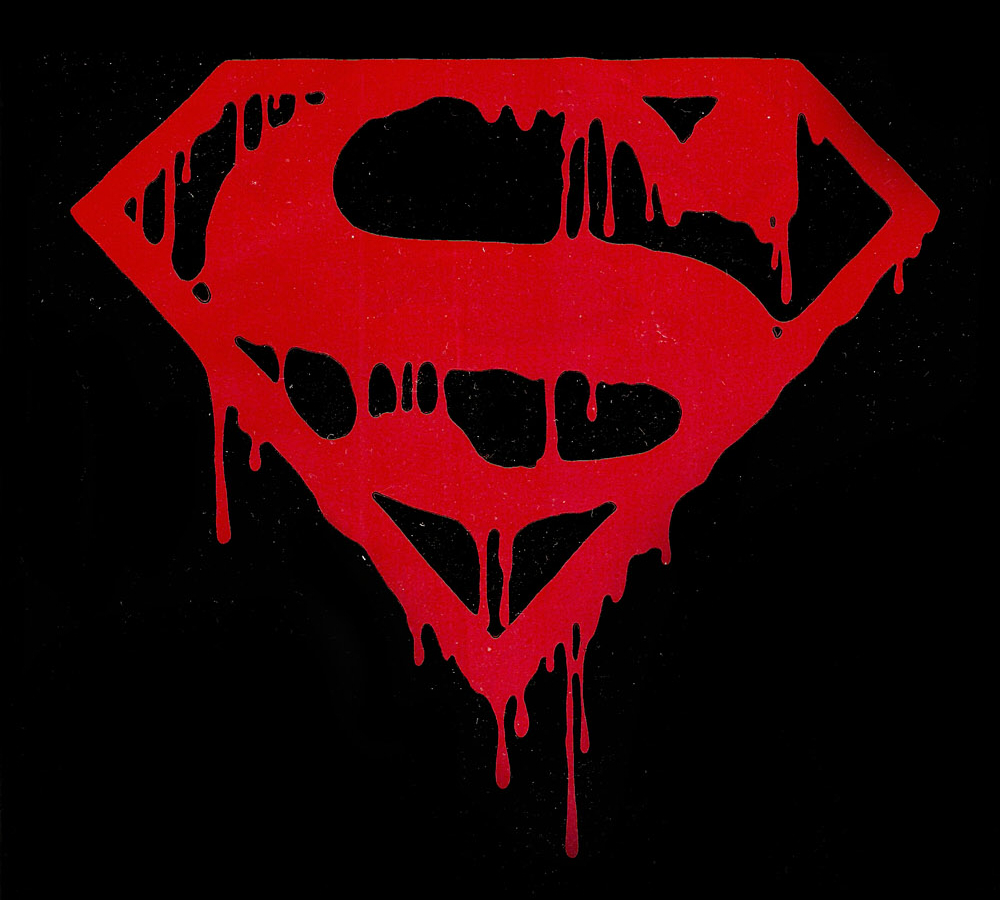
Starting this Monday and every Monday thereafter, LOSF will feature a regular column from me detailing and reviewing each issue of The Death of Superman storyline!
From Doomsday's first appearance in Man of Steel 17, to the final conclusion in Superman 83 I'll take a look at the best selling comic story of all time issue by issue, week by week, just as it appeared in newsstands.
If you always wanted to read this story, check it out along with me. For those who loved it when it first came out, give it another read. This is the story that, for better or for worse, defined American comic books in the 1990's, and it's getting the most in depth review we've ever done here at LOSF!
If there's a series, run, or selection of stories you'd like to see catalogued in this fashion next, please let me know in the comments thread!
Superman 400: "The Living Legends of Superman"

The single best comic ever produced by DC Comics, EVER.
Superman 400 is an exploration of the concept of the mythic hero, the historical figure, the person of interest as their story travels down through time and is received by further generations. This is Elliot S! Maggin's opportunity to fully flesh out his mythology of Superman's future, aided by the greatest team of artists to ever appear in a single issue of a comic. Seriously, check out this roster:
Joe Orlando; Howard Chaykin; Brian Bolland; Jack Kirby; Al Williamson; John Byrne; Jack Davis; Frank Miller; Leonard Starr; Walt Simonson; Marshall Rogers; Bernie Wrightson; Wendy Pini; Will Eisner; Mike Kaluta; Steve Ditko; Mike Grell; Klaus Janson; Moebius; Jim Steranko (writing his segment as well); Bill Sienkiewicz and Jerry Robinson. WITH an introduction by Ray Bradbury.
With a talent roster like that, you know it's time to just dive right in and see what we have. Please note, that because this issue is presented as an anthology we'll be doing capsule reviews, rather than a single essay which connects all these disparate parts, so that I can do justice to everything on it's own terms.
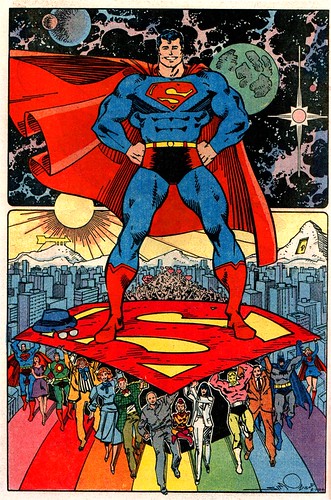
- As you can see above, Howard Chaykin's cover is a depiction of Superman forged directly from the souls of everyone who has ever loved him. Just amazing work.
- The framing story expresses the twin ideas of the piece: That time is a fixed point in time and that legends do not originate in a vacuum, but are animated by the people who transmit and receive them in powerful, simple, terms. This is just a wonderful metaphor for the continued creation of comic books through the ages, and it's expressed powerfully without being too "on the nose." Beautiful work.
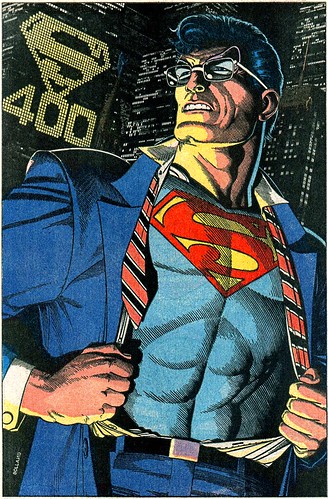
- Wow.
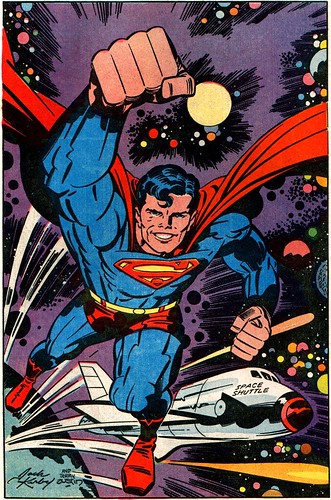
- There aren't enough Jack Kirby Superman images out there.
- The next piece is a wonderful yarn concerning a futuristic flim-flam man's tall tale about being saved by Superman in space, and discovering his "super serum" which he's now willing to sell. It's accompanied by drop dead gorgeous art, and it's a fun yarn. A comedic piece to whet our appetites for the more serious stories to follow. It doesn't make any less lovely to read, but it's not the sort of story that benefits from in depth review. Just read it.

- Interesting to see how Byrne saw Superman, just a couple years before he became the architect of his world. He's a little younger here than he looks in Byrne's origin for him a couple years later.
- Maggin teams with Frank Miller for the next segment which uses the Pre-Crisis concept of "Earth-Prime" (which is literally OUR Earth) for its springboard. Basically, scientists in the far future develop a device to obtain relics from parallel dimensions, and today they have obtained an episode of The Adventures of Superman 50's TV show from our world, and will use it to determine the age old secret of Superman's true identity. The debate between the reporter (who is a descendant of Jimmy Olsen) and the scientists over the accuracy of the evidence and the speculation concerning who Superman really was (it seems the majority opinion was on and off Superman baddie and Darkseid lackey Morgan Edge) feels like gentle mockery of the "debate" concerning Shakespeare's authorship. Great stuff.
- How many times can I say something's incredible?
- Marshall Rogers illustrates an offbeat story where Superman's indestructible costume allows a simple vagrant to incite a revolt against an oppressive regime. Superman, even without being present, is such a powerful symbol that he can rip whole communities out of apathy. An interesting inversion of the idea that superhero comics are fundamentally a "distraction" from the real world.

- Powerful, dynamic, work from a true master.
- The next story clocks in at just three pages as we watch two college professors in a space school argue about whether Superman was actually real. Nothing masterful, but the point being made that history fails to capture the true greatness of our finest heroes. Fun.

- Mike Kaulta's trademark style animates a neat slice of life from a far future Earth where children imagine themselves as a Superman, who they have subtly conflated with Batman (though he is never mentioned). Makes the point that the methodology of Superman is not nearly as important as the concept of Superman, which will always endure.

- Of course, Ditko makes the letter on the college sweater an A. Of course.

- Striking.
- Maggin's best story involves a futuristic seder meal for his Superman holiday Miracle Monday. Superman himself makes his only appearance in these stories, and is delighted to discover that he's become a kind of post-modern Elijah. The final evolution of probably the essential Jewish-American character. Not just great Superman, but truly great science-fiction.

- Very few images of Superman are haunting, this is one of them. From French legend Moebius.
- Steranko contributes the finale, where Superman and most of his descendents have transcended their physical form, and allow Superman's final descendent to stop the heat death of the universe and restore the universe's capacity for Life. Probably Steranko's greatest work, and that covers A LOT of ground.
Conclusion: This would be a satisfying final issue for Superman, and it doesn't contain Lois; Clark; the Daily Planet; the Legion; and barely contains Superman himself. Incredible, incredible. It places the Superman myth in incredible and varied contexts and makes the mind and spirit soar like truly great science fiction does. It gives you world after world that you want to live in.
READ IT HERE NOW: http://theages.ac/400/cover.html
Tuesday, June 25, 2013
Interlude: Superman, Lunchboxes, and the Most Important Thing in the Whole World

Superman isn't real.
That's what they tell me, anyway.
All Star Superman is a story filled with so many wondrous moments that it's difficult to single them out, but one in Issue 10 has never left me. Superman is well and truly dying, and as he compiles his will and tends to his affairs he wonders whether humanity will be able to exist without him. Can we save ourselves from our own basest urges? So, he creates an infant universe which will live and die in what are merely a few days of his time. As the comic book progresses the narrative splits between Superman's actions in one day and the progression of history through the millennia in Earth Q; we see cavemen, religious thinkers, Nietzsche, until the piece comes together in this panel which manages to be haunting and thrilling.

I don't want to get into all the specific textual implications of this panel rather, I want to talk about why it works so well. There's always been something about Superman, even when he wasn't my favorite character, that was so much more primal than any of the other super heroes. it's hard to put into words, but I think it's the absence of emotional gimmicks. He's here-- and he wants to do good because he can. It feels like real myth where the hero is singled out by virtue of being so much greater than his fellows, and in this case the absence of the usual traumas associated with superhero origins actually works to Superman's benefit. Just as villains who are evil for evil's own sake take on a truly grand, operatic quality so too are heroes who are good for its own sake.
At first the character's goodness was a hard-edged thing: innocents were defended, criminals were harshly punished. He was as swaggering and physical as any adventure hero. As the character developed, the writer's conception of better became more sophisticated. Superman could not simply be better by virtue of his superhuman power and having the right ideals, his methods, his home(s), his past, his future (and the times when they overlapped), his friends, his enemies were all elevated. Superman stories of the 50's and 60's, in their juvenile ways, actually examined the question of what it meant to be the ideal of humanity at the same time you were fundamentally distanced from it. To borrow words from my youth he was "fully god and fully man."
The slightly paradoxical element of all this rambling, is that the more anti-real he became, the more outlandishly honorable he is presented, the clearer the essential message he projects becomes.

More than Green Lantern or Captain America, or even the X-Men, (all wonderful characters in their own right) Superman is a wonderful and poetic archetype whose mission is to express to us the most essential ethical truths we know. He exhibits a moral standard, which helps inform our daily lives.
There's a certain cynicism about comic book characters, about how marketable and commercial they've become, but no media blitz, or endless exploitation, or lousy movie can snuff out what is good and pure and true about Superman. that's what this site is truly about.
Long live Superman.
Sunday, June 23, 2013
Superman Unchained 1: "The Leap"

I normally reserve this space for comics which are good, or at the very least interesting failures. However, this is DC's prestige Superman project led by it's biggest exclusive artist (who is part of management) and its A list writer. It was marketed specifically to capitalize on the success of Man of Steel, and is intended to be both an introduction to the contemporary Superman, and a high concept, high energy adventure for loyal Superman fans.
I'm not sure it succeeds on those terms.
The story is pretty thin, and feels like the first issue of a new run on Adventures of Superman in the early 2000's. It's dated, bland, stuff that I must have read a million times before. Point by point:
- I have no problem with the appropriation of Nagasaki for this comic's first scene, in theory. Some very fine science fiction authors have shown us that alternate history can be a springboard for great stories. However, real tragedies should be used with some real respect. You don't have the small Japanese boy who's about to be atomized by the weird blue energy man call out his own version of "It's a bird..." That makes you look emotionally tone deaf and exploitative. What did we gain from this scene that couldn't have been implied?
- The showcase sequence for Superman is problematic. Snyder borrows Jeph Loeb's trick of having Superman recall an anecdote from childhood that serves as a metaphor for what he's doing at that moment. I've seen this done a lot, but it's not a cardinal sin to borrow a successful beat from another writer. What is call for penance is the art: stiff, generic, hampered by a silly poster gimmick that borders on a real embarrassment. One side requires you to find the text box to know which way to hold it, and other is an impact shot with no force or visible effort. Not a disaster, but not what I'd expect from the DC A-team. The rest of the rescue is played big, but there's a giant missed opportunity as we are let in on Superman's thought process...only to find that he thinks exactly the same way you or I would. Doesn't this man's mind move at a million miles an hour? Haven't we any more insight than this?
- Superman recognizes the MO of bringing down satellites from one of Lex Luthor's term papers, so he goes to confront Lex as he's being transferred from his one man SuperDuperMax from Lobdell's recent issues on Superman to Gen Pop at Stryker's. Lex is shown here as the stupid person's idea of the world's smartest man. He's reading the Iliad (in translation, which doesn't seem right, and I suspect was done because Jim Lee can't be bothered to research what Ancient Greek letters look like), and when Superman attacks the copter he folds two of the pages into an origami skyline of Metropolis to show Superman what he's been working on. He exudes neither menace nor charm, and seems altogether like a wayward professor with delusions of grandeur and a taste for arts and crafts. It would have made a lot more sense if he had been absent mindedly doodling his new invention in the margins, but whatever. Other than mentioning the terrorist group Ascension for the second time in four pages this does nothing.
- The scene with Lois and Jimmy is just badly constructed. This scene exists to give two vital pieces of information: To explain Clark Kent's job status to new readers and to reveal to Clark that persons unknown saved one of the satellites he had given up on. It's crammed with so much unnecessary detail visually and textually that we're in danger of losing it. Less is more. Also, I got that Ascencion was important the first time, Scott, you don't have to keep mentioning them to me.
- Superman investigates the lost satellite, is fired on by an American sub, and we learn that the military has the Superman from Nagasaki in that location. Can anyone write an actual cliffhanger anymore? That's just a development, not something that makes me count the days till Issue 2, AND it's info we got on Page 3. Sloppy, lazy, writing.
- A two page epilogue (that Jim Lee couldn't be bothered with) reveals the crucial information that Perry White has ancestral binoculars that no longer work, and burned up man pulled from the ocean by a fishing trawler wants to see Lois Lane. Thrilling.
Conclusion: Events like this settle in the consciousness of readers and will help them determine just who and what this new Superman is to be. It's nice of Jim Lee and Scott Snyder to have made this one bland enough to escape notice, then. DC have had two tries at defining this new Superman in the almost two years since his debut in Justice League 1: Morrison's run on Action Comics and Lobdell's H'el on Earth storyline. Those two stories aren't playing on the same field with one another in terms of quality, but at least they were big bold adventures that took chances and felt fresh. This is yesterday's news for the Man of Tomorrow.
Not recommended.
Subscribe to:
Posts (Atom)